
Kohlrabi gets shelved with the root vegetables and grown like one, but its swollen edible part is a stem, sitting entirely above the soil the whole time. Per UMN Extension: what that actually changes about how you plant it, when it bolts, and how you tell it's ready, since there's no root shoulder to watch for.
Tom Marsh
I grow food: vegetables, herbs, fruit. I try to be honest about yield. Celery regrown from a scrap gives you one modest bonus harvest, not a new celery, and I'd rather say so than sell you the photo. When a timing or a number comes from my own kitchen rather than a source, I label it that way in the guide.
My Garden Journal
It Looks Like a Root Vegetable. It Isn't One.
Radish, turnip, beet, and carrot all swell a real root underground, and you learn to read the soil surface for a shoulder pushing up as the signal that it's ready. Kohlrabi breaks that pattern entirely. Per University of Minnesota Extension: "Kohlrabi (Brassica oleracea var. gongylodes) is an odd-looking garden plant. It has a bulbous, enlarged stem just above the soil surface, topped with upright thick leaves." The part you eat is a stem, not a root, and it's visible in open air from the day it starts swelling. There is no hidden-then-revealed moment here. If you're watching the soil line for a cue the way you would with radish or turnip, you're watching the wrong thing, because there's no soil to break through.
Kohlrabi is also, per UMN, "the same species as cabbage, cauliflower, broccoli, turnip and kale," which is why it shares most of that family's growing needs and diseases, even though the harvested part looks nothing like any of them.
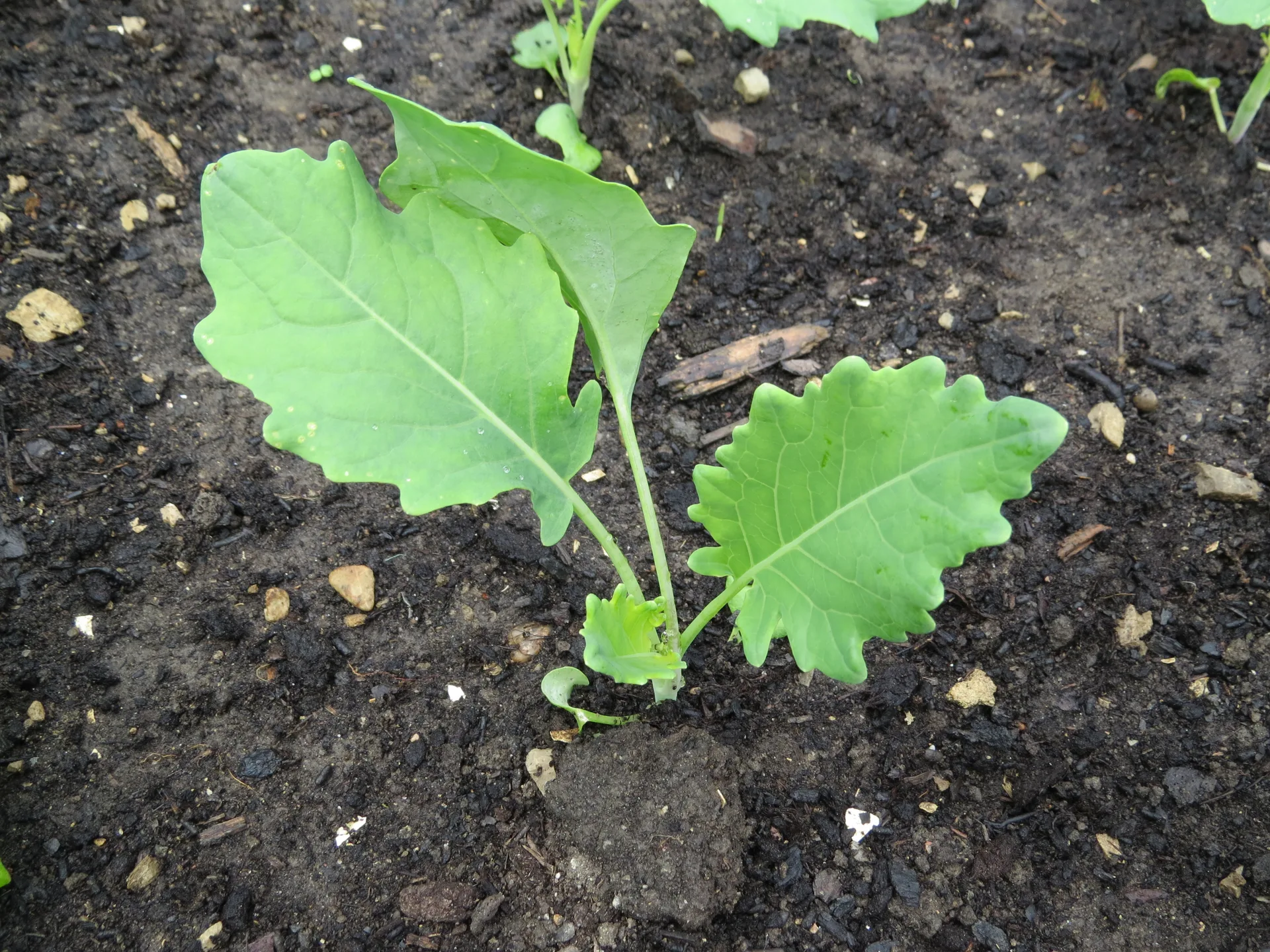
Planting: Two Very Different Windows
Per UMN, spring and fall kohlrabi are grown almost like two different crops. For spring, direct-seed from mid-April to early May, at about 1in spacing and 1/4 to 1/2in deep, then thin to 4in between plants once seedlings emerge. Choose a variety with a low days-to-harvest number, 35 to 45 days, for the spring window; UMN is explicit that "it is better to grow giant kohlrabi as a fall crop" rather than trying to push a large variety through spring's shorter cool window. UMN also gives a hard planting cutoff for spring: "avoid planting after May 1. The high temperatures will not produce good quality."
The fall window is different in both timing and scale. Direct-seed in July; giant types take about two months to mature, and "a late July planting will be ready to harvest before a hard freeze." Fall-harvested kohlrabi, per UMN, "can grow a bit bigger without losing quality" than a spring-grown bulb pushed past its prime, and some varieties can stand real cold in the garden without splitting.
Bolting: A Cold Snap, Not Just Heat
Most of this site's cool-season crops bolt from heat. Kohlrabi can bolt from cold instead, in its spring planting specifically. Per UMN: "if the plants experience late spring frosts, or more than a week of nights below 50F, they may bolt (produce a flowering stalk and stop growing) once warm weather returns." UMN does not give a bolt rate or a firmer temperature-duration threshold beyond that qualitative description, so that's the limit of what this guide states: a week or more of sub-50F nights is a named risk condition, not a guaranteed outcome with a known percentage.
Harvest: Pure Measurement, No Reveal
Because the bulb sits in the open the entire time, harvest readiness comes down to one number. Per UMN: "harvest kohlrabi when the bulb is two to three inches in width. If the bulb gets too large, it will become tough, woody and bitter." There's no test-pull the way you'd tug a radish to check size, and no shoulder to watch for the way beet or turnip give you. You look at it and measure it. UMN also notes spring-planted kohlrabi is more likely to turn fibrous if left past its window than fall-planted kohlrabi, which tolerates a bit more size before quality drops.
The Leaves Aren't Wasted Either
Per UMN, "once harvested, the leaves are also tasty. You can use the leaves as cooking greens," the same way you would kale or collard greens, which makes sense given the shared species. This isn't the tradeoff structure of turnip greens, where cutting leaves early costs you root size; here the bulb and leaves come off together at one harvest, so there's no competing-resource decision to make, just an extra edible part that's easy to overlook if you're only thinking of kohlrabi as "the weird bulb thing."
Storage and Rotation
Per UMN, kohlrabi keeps about two weeks in a home refrigerator. Longer storage, months at 36F and 95% humidity, needs conditions UMN describes as "hard to create... outside of commercial storage facilities," so don't plan on a home root cellar matching that. On rotation: avoid planting kohlrabi where broccoli, cauliflower, collards, kale, turnip, rutabaga, cabbage, mustard, bok choy, or Brussels sprouts grew in the previous four years, since all of these share kohlrabi's susceptibility to clubroot, black rot, and alternaria leaf spot.
What This Is (and Isn't) Worth
Worth doing: a fast, genuinely different crop from anything else on this list, with an easy visual harvest check and a fall window that produces a bigger, better bulb than spring will. The leaves are a real bonus, not a consolation prize.
Not worth doing: expecting it to behave like a root vegetable once it's in the ground. If you've grown radish or turnip and you're watching for a shoulder at the soil line, you'll miss the actual signal and likely harvest late, since by the time a kohlrabi "shows" anything at soil level it's already well past ready.
Related Guides
- Turnip Greens: A Real Crop, Not a Kitchen-Scrap Trick, the nearest guide by shelf adjacency (both are round, purple-tinged brassicas often grouped together) but genuinely different: turnip's swollen part really is a root, and that guide is about the leaf-regrowth tradeoff, not the main organ.
- Growing Radishes: Why Crowded Roots Never Bulb, the nearest guide by mechanism (both are fast, narrow-harvest-window crops that go tough or bitter if missed, both can bolt) but the read is opposite: radish signals readiness by a root shoulder breaking the soil surface, kohlrabi by pure visible width with no reveal moment at all.
- Growing Palak (Spinach): When to Sow, How to Grow, and What to Do in Summer, a genuine cool-season-crop neighbor (both prefer the same 65-75F range UMN names for kohlrabi) and a fit for the zero-inbound-link floor input, not forced.
FAQ
Is kohlrabi actually a root vegetable?
No. Per UMN Extension, the edible part is "a bulbous, enlarged stem just above the soil surface," not a root. It's the same species as cabbage and kale, and its growing needs follow from that, not from being a root crop.
Why did my kohlrabi bolt in spring?
Per UMN, spring kohlrabi can bolt (send up a flowering stalk and stop growing) after "late spring frosts, or more than a week of nights below 50F." UMN doesn't give an exact bolt rate for this, so treat it as a named risk condition tied to a cold stretch, not a guaranteed outcome.
How do I know when to harvest, if there's no soil cue like other root crops?
Per UMN, harvest at 2 to 3 inches of bulb width, checked by direct measurement, since the bulb is visible above the soil the entire time it's growing. There's no shoulder or test-pull signal the way radish or turnip give you.
Can I eat the kohlrabi leaves too?
Yes. Per UMN, "once harvested, the leaves are also tasty. You can use the leaves as cooking greens." They come off with the bulb at the same harvest, so there's no separate leaf-versus-bulb tradeoff to manage.
Related Topics
Share This Guide
Related Guides
Continue learning with these related guides