
Fine webbing, stippled leaves, and specks that move. Here is how to confirm spider mites (Tetranychus urticae), why they explode in dry heated air, and which treatments actually have evidence behind them.
Mira Castellanos
I keep houseplants and I read the actual studies, which is usually either a confession or a dare. If a claim isn't sourced I'll write 'gardeners report' rather than state it as fact, and if a mechanism is only partly supported I'll tell you which part. Plenty of popular plant advice does not survive that treatment.
My Garden Journal
What You're Actually Looking At
Spider mites aren't insects, they're arachnids, close relatives of ticks and spiders. The species behind almost every houseplant infestation is Tetranychus urticae, also called the two-spotted spider mite, and adult females measure about 0.4 mm long. At that size you generally can't identify one with the naked eye; what you can see is the damage and, in a heavy infestation, the mites as tiny moving dots.
Confirm before you treat. Hold a sheet of white paper under a leaf and tap it firmly. If specks fall onto the paper and start crawling, you have mites. Stippling alone (see below) can look similar to thrips or fine dust, so this five-second test is worth doing before you commit to a treatment plan.
Signs to check for
- Stippling: tiny pale or yellow dots on the leaf surface, usually starting on older or lower leaves
- Fine webbing across leaf joints, along stems, or spanning the underside of a leaf, this is the most specific sign and, once present, means the infestation is established
- Bronze or dusty-looking foliage on heavily fed leaves
- Leaf drop in advanced infestations
Mites feed by piercing individual leaf cells with a stylet and removing the contents. Each puncture kills that cell, which is what produces the stippled, pale-speckled look; a heavy colony can produce thousands of these lesions and measurably cut a plant's photosynthetic capacity.
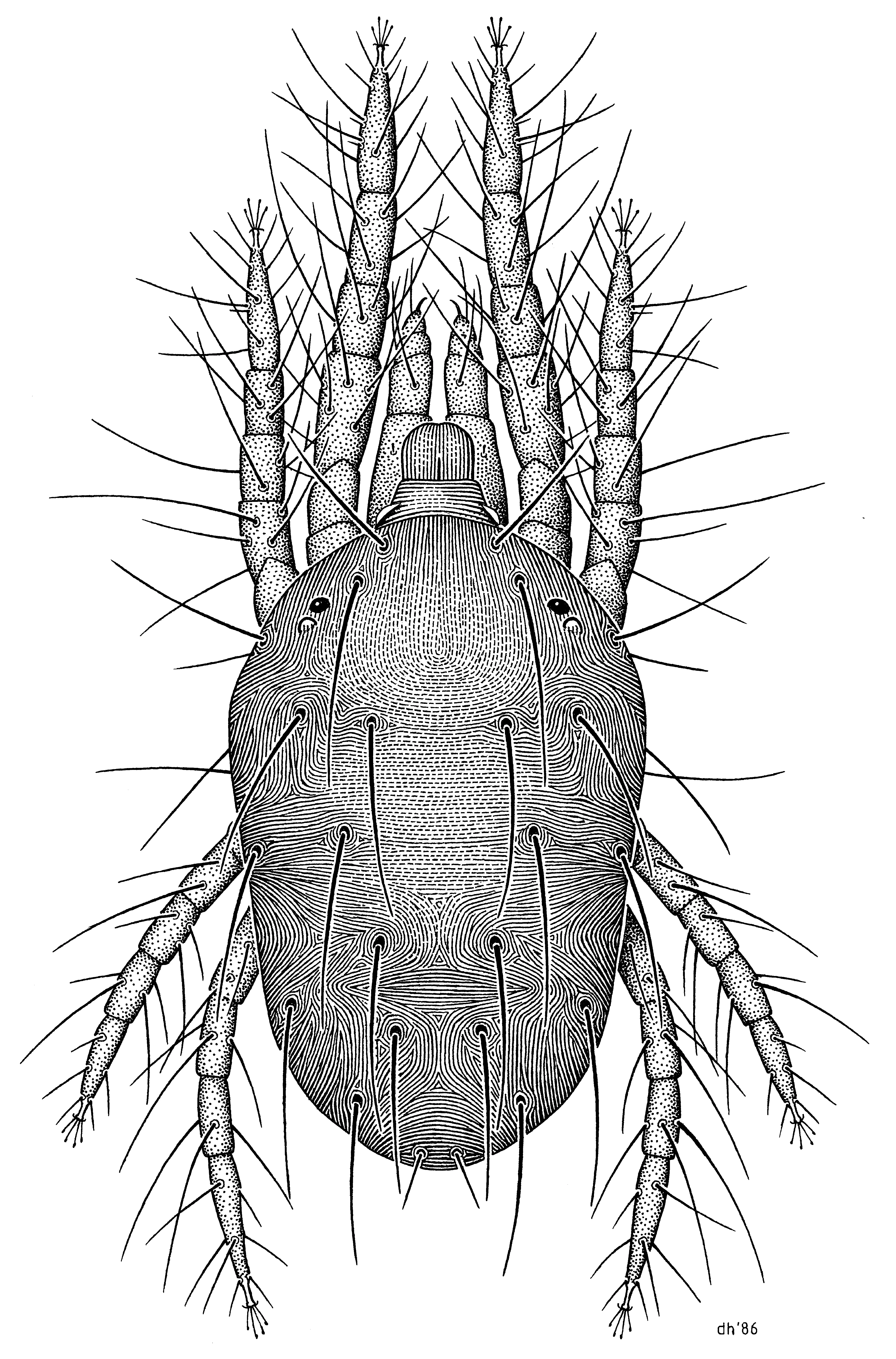
At this magnification you can see the features the naked-eye test above can't show: eight legs (confirming arachnid, not insect), the piercing mouthparts, and the segmented body plan shared across the Tetranychidae family. This is what's actually crawling on the paper in the tap test.
Why They Explode Indoors in Winter
This is the part worth understanding, because it explains both why mites show up when they do and why "just wipe the leaves" alone rarely holds them off.
T. urticae populations grow fastest in hot, dry conditions: research summarized by Iowa State University Extension puts rapid population growth above roughly 85°F (29°C) with relative humidity under 90%, and a single female can lay on the order of 100 eggs in her lifetime. Under favorable conditions, a colony can expand up to 70-fold in as few as six days. Heated indoor air in winter, when furnaces and radiators routinely push relative humidity well under 30%, is close to ideal for them, even though the room itself feels nowhere near "hot" to a person. That combination, warm room air and low humidity, is the actual driver, not the season on the calendar.
Their natural check outdoors is partly a fungal pathogen that thrives in humid conditions and suppresses mite outbreaks; indoors, in dry air, that check is largely absent. This is one reason raising humidity is not a cosmetic add-on to treatment, it removes the condition the mites depend on. For the mechanics of actually raising humidity around your plants (pebble trays, grouping, humidifiers, and what doesn't work), see the houseplant humidity guide.
Treatment That Has Evidence Behind It
1. Mechanical removal first
Before reaching for any product, a firm rinse under the tap or in the shower physically knocks mites and their webbing off the plant. This alone reduces the population and is the step with the least risk of harming the plant or anything else living near it. Do this outdoors or in a sink where you can rinse the underside of every leaf.
2. Neem oil (azadirachtin)
Neem's active compound, azadirachtin, does not work as a contact poison the way a household insecticide spray does. It acts as an antifeedant and insect growth regulator, it disrupts molting and reproduction and deters feeding rather than killing on contact. That means results build over repeated applications (roughly every 5-7 days) rather than showing up immediately after one spray, and thorough coverage of leaf undersides matters more than spray volume.
Worth naming plainly: azadirachtin is described as low-risk to bees and most non-target arthropods, but the same sourcing specifically excludes ladybirds and lacewings from that low-risk profile, both of which are natural mite predators. If you later introduce predatory mites (below) or want to protect existing beneficial insects on the plant, that's a reason to stop neem applications first rather than run both at once.
3. Insecticidal soap
A soap solution (roughly 1 tsp mild dish soap or insecticidal soap concentrate per quart of water) works by disrupting the mites' outer coating on contact. Like neem, it only affects what it directly touches, so it requires full coverage of leaf undersides and repeat applications through the mites' 5-20 day generation cycle to catch newly hatched mites the first pass missed.
4. Predatory mites (biological control)
Phytoseiulus persimilis is a predatory mite species used commercially as a biological control specifically because it preys on spider mites. This is a serious option for a heavy or recurring infestation on a valuable plant, but it is incompatible with neem or broad-spectrum sprays run at the same time, you're either supporting a predator population or suppressing all mite life indiscriminately, not both.
5. What to avoid
Extension guidance for field crops is blunt on this point and it holds indoors too: broad-spectrum insecticides, especially pyrethroids, kill the mites' natural predators (ladybugs, lacewings, and other predatory mites) without reliably killing mite eggs, and can trigger a population rebound larger than the original infestation. If a product isn't formulated as a miticide or an insecticidal soap/oil specifically labeled for mites, it's a reasonable guess that it will do more harm to your plant's other defenses than to the mites themselves.
What I'm Leaving Out On Purpose
I can't give you a reliable "X days to clear an infestation" timeline. The sourcing I read this turn gives generation times (5-20 days) and population growth rates under specific outdoor/greenhouse study conditions, not treatment-response timelines for a single potted houseplant in an apartment. Anyone who gives you a precise day count for a home infestation is extrapolating past what the underlying research actually measured, so I'd rather tell you to watch for stippling to stop spreading and webbing to stop reappearing after treatment than hand you a number I can't back up.
Prevention
- Isolate new plants for one to two weeks before placing them near your collection, mites travel readily from an infested plant to its neighbors
- Raise ambient humidity above the range mites favor, see the houseplant humidity guide for methods that actually move the number
- Inspect the undersides of leaves periodically, catching a colony before webbing appears is far easier than treating an established infestation
- Avoid drought stress, and avoid broad-spectrum pesticide use nearby, for the flare-up reason above
Related Reading
- Houseplant humidity guide, for the specific methods (pebble trays, humidifiers, grouping) that lower a mite population's favorite conditions
- Indoor plant pests: identify and treat, for the other six common houseplant pests and how to tell them apart from mite damage
- Yellowing leaves diagnostic guide, since stippling is sometimes mistaken for early nutrient or watering stress
Related Topics
Share This Guide
Related Guides
Continue learning with these related guides
Also in Indoor Plants
"Bright Indirect Light" Has No Agreed Number
Is Pothos Really Unkillable? The Overwatering Myth Nobody Warns You About
Does Cinnamon Actually Help Houseplants? The Lab Result and the Garden Claim Are Not the Same Study
Ponytail Palm Isn't a Palm: What the Name Gets Wrong About Its Care